Quick answer
Once a salvage yard buys your car, it stops being a vehicle in the eyes of Alberta and becomes a source of parts and scrap metal. The yard reports it to the Registrar as non-repairable, drains every fluid, pulls anything reusable, then crushes and shreds the shell for metal recovery. Under Alberta’s Vehicle Inspection Regulation that change happens on the day of purchase, and from then on the car is defined as having no value except as parts or scrap metal.
Step 1: the paperwork changes the car’s legal status
The first step is paperwork. Section 12 of the Vehicle Inspection Regulation (AR 211/2006) says anyone who buys a salvage motor vehicle for scrap or parts, or who starts dismantling one, must notify the Registrar of Motor Vehicles within 6 days that the vehicle is now non-repairable.
The same section says the vehicle becomes non-repairable on the date of purchase if it was bought for scrap or parts. So the moment you take cash from us or hand the keys to our tow driver, the clock has started. That is the point of no return: section 6 defines a non-repairable vehicle as one with no resale value except as a source of parts or scrap metal.
For you, the practical result is that the VIN is closed off. Nobody can patch the car up and put it back on a Calgary road under your old plate. Alberta’s Vehicle Information Report shows a vehicle’s status (active, salvage, rebuilt and so on) to anyone who searches the VIN, so the record follows the car, not the owner.
Step 2: fluids and hazardous components come out first
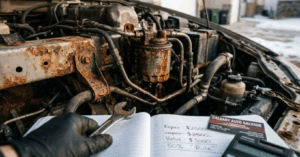
Before anything is cut or crushed, the car is depolluted. Engine oil, transmission fluid, coolant, brake fluid, power steering fluid, washer fluid and leftover fuel are drained into separate containers, because each stream goes to a different recycler.
The battery is pulled for lead-acid recycling. Any refrigerant left in the air conditioning is recovered with a machine rather than vented. Undeployed airbags and seat-belt pretensioners are removed or deployed in a controlled way, because a live inflator in a crusher is a hazard for the crew.
This is why we ask you to leave the car in one piece. A car that arrives with an open fuel line or a cut battery cable is slower and less safe to handle, and it does not change what you get paid. Our offers run from $200 to $10,000 depending on the vehicle.
Step 3: reusable components are pulled
With the car drained and safe, it moves to dismantling. Wheels and tires come off, then the components with value: engine and transmission if they run, alternator, starter, radiator, catalytic converter, straight body panels, lights, mirrors, seats and electronics.
To be clear: Calgary Auto Salvage does not sell parts to the public. We buy whole vehicles, process them properly and move the recovered materials on through the recycling chain. If you need a used door or mirror for another car, a parts recycler is the right call, not us.
Catalytic converters, aluminum rims and copper wiring harnesses are sorted separately, since each metal is worth more clean than mixed into a general steel bale.
Step 4: the hulk is crushed and shredded
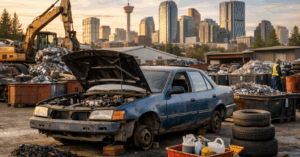
What is left is the hulk: the unibody or frame, remaining steel, glass, plastic trim, carpet and foam. It goes through a crusher, which flattens it so a trailer can carry many at once, and then to a shredder.
A shredder tears the flattened car into fist-sized pieces in seconds. Magnets pull out the steel, which goes to a mill to be melted down. Eddy-current separators pick out aluminum and copper. The remainder, called shredder residue or fluff, is the plastic, foam, rubber and glass that could not be separated, and that fraction goes to landfill or energy recovery depending on the processor.
Steel is the biggest reason old cars have value at all. The metal does not wear out, it gets re-melted, which is why a non-running vehicle from the 1990s still gets a cash offer and free towing from us.
What does salvage status mean in Alberta?
People use “salvage title” loosely, so it helps to see what the regulation actually says. Section 2 of the Vehicle Inspection Regulation makes a car a salvage motor vehicle when it is damaged and an insurance company replaces it, pays out and takes ownership, or pays out the pre-damage value without taking ownership. A stolen vehicle recovered with damage and paid out by the insurer also becomes salvage. Hail damage to the outer sheet metal alone does not trigger salvage status.
Section 6 goes a step further. A salvage vehicle is non-repairable if it has no resale value except as parts or scrap. The regulation lists examples: flooded to the bottom of the dashboard, burned in two or more compartments, a unibody with collision damage into the floor, cowl and A-pillar, or a full-frame vehicle needing both the cab and the frame replaced. And, as covered above, any salvage vehicle bought for scrap or parts becomes non-repairable at purchase.
The Registrar can also assign salvage, non-repairable or unsafe status directly under section 8 if a vehicle poses a safety hazard. Whoever sells a salvage vehicle must give the buyer a current salvage inspection certificate or a written statement that none exists (section 13).
Can a salvage vehicle ever go back on the road?
A salvage vehicle can. A non-repairable vehicle is, by definition, parts and scrap, and the regulation’s route back to registration (a salvage inspection certificate under section 18) is written for salvage vehicles. Alberta’s salvage vehicle inspection page explains the route: repairs to structural or occupant-protection areas must follow OEM or I-CAR methods, the owner buys a Request for Vehicle Inspection at a registry agent, completes a Rebuilt Vehicle Work Plan, then presents the car at a licensed inspection facility. The inspection can take up to 4 hours and the facility sets its own price.
If it passes, the status changes from salvage to rebuilt, the car can be registered again, and rebuilt stays on the record for life. The certificate must reach a registry within 14 days or a full re-inspection is required.
That is the fork that matters for a wrecked car. If the insurer wrote it off but the structure is sound, a rebuilder might pay more than a salvage yard. If the damage is on the section 6 list, or the repair math does not work, selling for salvage is the honest end of the story.
Your paper trail after the sale
The yard handles the non-repairable notification. A few things are still on you:
- Keep the bill of sale we give you, with the VIN, date and amount, so you can prove the date ownership changed.
- Take your licence plate off before the tow. Plates belong to you, not the car.
- Cancel the registration at a registry agent using the Licence Plate Cancellation form. Bring ID and the plate; a $10 plus GST cancellation fee is deducted and any refund arrives by cheque in roughly 4 to 6 weeks.
- Call your insurer and cancel or transfer the policy once the registration is cancelled.
What to do next
If you have a car that is done, whether an insurer already declared it salvage or it simply will not pass another year, call Calgary Auto Salvage at 403-614-2357. We are open 7 am to 9 pm, seven days a week, pay $200 to $10,000 cash for whole vehicles and tow for free anywhere in Calgary. Our yard is at 4035 14th St SE, Calgary T2G 3K6 if you would rather drive it in yourself. Bring your ownership document and ID, and we handle the rest.